Anxiety does not always arrive as a clear thought that says, “I am anxious.”
Sometimes it looks like overthinking a conversation long after it has ended. Sometimes it is a tight chest, restless sleep, difficulty concentrating or feeling constantly on edge. For other people, it can feel like shutting down, avoiding situations or simply knowing that something does not feel right without being able to explain why.
Talking about these experiences can be helpful, but finding the right words is not always easy.
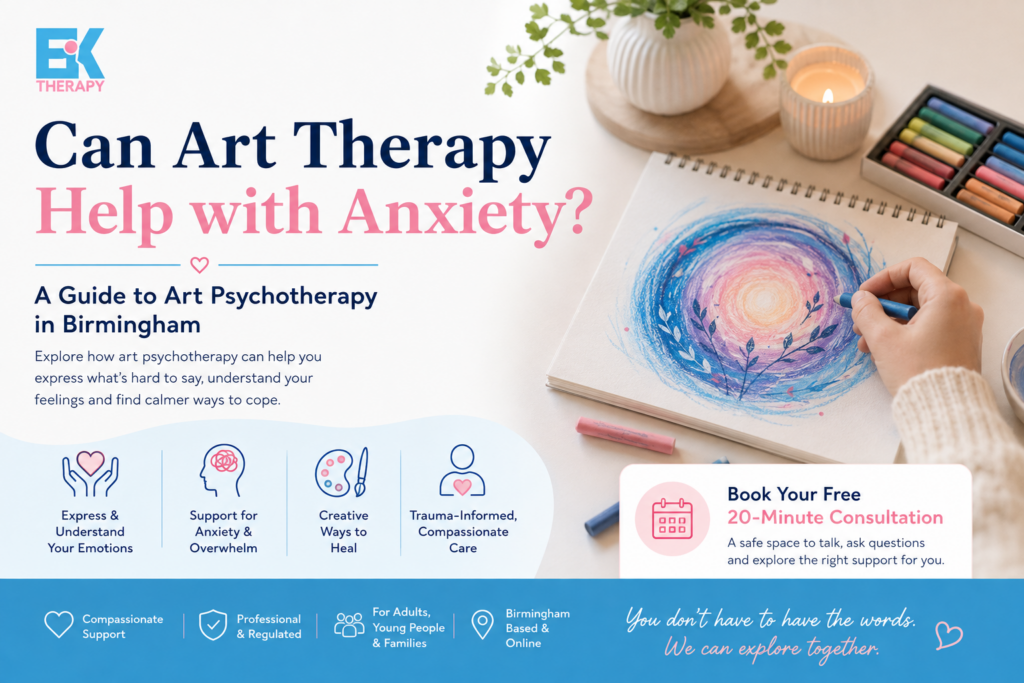
This is one reason some people explore art therapy for anxiety. Art psychotherapy provides another way to notice, express and understand emotional experiences, using creative expression alongside the relationship and conversation with a trained therapist.
At EK Therapy, our approach recognises that people communicate and process experiences in different ways. For people looking for art psychotherapy in Birmingham, creative therapy can offer space to explore what may feel difficult to put into words.
What is art psychotherapy?
Art psychotherapy, often referred to as art therapy, is an established form of psychotherapy.
The British Association of Art Therapists explains that art is used as a primary form of expression alongside talking with an art therapist. The focus is not on producing attractive artwork or learning artistic techniques. Instead, the creative process becomes part of exploring thoughts, feelings and experiences.
You do not need to be artistic.
You do not need to know how to draw.
And you do not need to arrive knowing exactly what you want to create.
An art psychotherapy session might involve drawing, painting, colour, collage, clay or other creative materials, depending on the therapist, the setting and what feels appropriate for you.
Sometimes a person may create something and talk about it. At other times, the process of making something may be more important than explaining it.
Can art therapy help with anxiety?
Anxiety can affect both thoughts and physical experiences.
A person may notice:
- Constant worrying or overthinking
- Difficulty switching off
- Feeling tense or restless
- Trouble concentrating
- Avoiding certain situations
- Feeling overwhelmed easily
- Sleep difficulties
- Physical sensations such as a racing heart or tense muscles
The NHS describes anxiety as something that can involve both psychological and physical symptoms.
Art psychotherapy does not promise to make anxiety disappear. Instead, it can provide a therapeutic space to become more curious about what is happening, recognise patterns and explore feelings in ways that do not rely entirely on conversation.
BAAT also describes art therapy as a way of expressing complex thoughts and feelings through art-making, including experiences that may be difficult to talk about directly.
Why can anxiety be difficult to explain?
Many people understand that they are struggling but cannot immediately explain why.
You might say:
“I know I am worried, but I don’t know what I am worried about.”
Or:
“I understand it logically, but I still feel anxious.”
Sometimes feelings arrive before we have language for them.
For another person, talking itself may feel uncomfortable. They may have spent years keeping difficult experiences private, minimising their feelings or trying to remain strong for other people.
Creative therapy offers another place to begin.
A shape, colour, image or piece of artwork does not need to explain everything perfectly. It can simply provide something to notice and explore with the therapist.
You do not have to be “good at art”
This is one of the most common concerns people have before considering art psychotherapy.
Art therapy is not an art lesson.
There is no grade, competition or expectation to produce something impressive.
You might draw something very simple. You might choose colours without knowing why. You may make marks on paper, create a collage or decide that you would rather talk during a particular session.
The therapeutic value is not determined by artistic ability.
The relationship between you and your therapist remains central to the work.
What might happen in an art psychotherapy session?
Every therapist works differently, and sessions are adapted to the individual.
A session may begin with conversation about how things have been since you last met.
Your therapist might then invite you to notice what feels important that day. Art materials may be available, but you should not feel pressured to use them.
If you choose to create something, the therapist may give you time and space to work.
Afterwards, you may look at what you have made together.
You might notice:
- A feeling connected to a particular colour
- An image that reminds you of something
- A repeated pattern
- A physical response while creating
- An emotion that became clearer
- Something you want to talk about
- Something you are not ready to discuss
There is no single “correct” interpretation.
Art psychotherapy is not about a therapist looking at your picture and telling you what it secretly means.
Instead, the therapist can help you explore your own experience and meaning at a pace that feels manageable.
How might creative therapy support someone experiencing anxiety?
1. Giving feelings somewhere to go
Anxiety can sometimes feel difficult to organise into sentences.
Creating something can provide another way to externalise an experience rather than keeping everything inside your thoughts.
Seeing something in front of you may make it easier to reflect on what you are experiencing.
2. Slowing down
An anxious mind can feel very busy.
Creative activity can introduce a different pace into a therapy session.
Rather than immediately trying to solve a problem, you may have space to notice colours, textures, movements, sensations and emotions.
The purpose is not simply distraction. The creative process can become part of understanding what is happening internally.
3. Recognising emotional patterns
Over time, therapy may help you become more aware of situations, relationships or thoughts connected with anxiety.
Perhaps you notice that certain feelings appear when you are under pressure.
Maybe anxiety increases when you need to set a boundary, enter an unfamiliar situation or worry about disappointing somebody.
Greater awareness does not automatically remove a difficult feeling, but it can make that feeling less confusing.
4. Exploring experiences that are hard to verbalise
Some experiences are difficult to explain directly.
This can be particularly relevant when someone has experienced trauma, loss, major life changes or emotions they have kept private for a long time.
Creative expression can provide another route into that experience without requiring everything to be put into words immediately.
5. Building a more compassionate understanding of yourself
People experiencing anxiety can sometimes become frustrated with themselves.
“Why can’t I just stop thinking about this?”
“Why am I reacting like this?”
“Why can’t I cope like everyone else?”
Therapy can create space to replace some of that judgement with curiosity.
Instead of asking only, “How do I stop this feeling?” you may gradually begin asking:
“What might this feeling be telling me?”
“What happens before I become anxious?”
“What helps me feel safer or more settled?”
Is art therapy only for children?
No.
Creative approaches are often associated with children because young people may naturally communicate through play, images and creativity.
However, art psychotherapy is also used with adults.
BAAT describes art therapy as an established psychological therapy that can support people across different ages and circumstances.
At EK Therapy, creative approaches can be used with adults as well as children and young people, depending on the service and therapist.
Parents looking for support for a younger person can also read about Child and Adolescent Therapy in Birmingham.
What is the difference between doing art at home and art psychotherapy?
Creative activities can be enjoyable and meaningful outside therapy.
Painting, drawing, journalling or crafting may help someone relax or express themselves.
But doing something creative by yourself is not the same as art psychotherapy.
Art psychotherapy takes place within a therapeutic relationship with an appropriately trained professional.
In the UK, Art Therapist and Art Psychotherapist are protected professional titles regulated by the Health and Care Professions Council.
This is an important distinction when choosing support.
What if I prefer talking?
That is completely valid.
Creative psychotherapy does not have to mean replacing conversation.
Some people use art regularly during therapy. Others use it occasionally. Some may find that talking feels right in one session while creative expression feels more useful in another.
The approach should respond to the individual rather than forcing somebody into one way of working.
EK Therapy’s Creative Therapy in Birmingham combines creative, relational and trauma-informed approaches, with attention to what feels appropriate for each person.
Who might consider creative therapy?
Someone may consider art psychotherapy if they:
- Experience anxiety or persistent worry
- Feel emotionally overwhelmed
- Find it difficult to express feelings verbally
- Feel disconnected or emotionally numb
- Are processing grief or loss
- Have experienced difficult or traumatic events
- Notice repeated emotional or relationship patterns
- Feel more comfortable expressing themselves creatively
- Want to explore themselves in a different way from talking alone
This list does not mean art psychotherapy is necessarily the right approach for everyone.
A consultation with a qualified therapist can help you discuss what you are experiencing and whether the approach may be suitable.
Choosing an art psychotherapist in Birmingham
If you are considering art psychotherapy in Birmingham, qualifications and professional registration matter.
Check whether the practitioner is appropriately trained and registered for the professional title they use.
The HCPC maintains a public register that can be used to check regulated professionals.
You may also want to consider:
- Who the therapist usually works with
- Their experience and therapeutic approach
- Whether sessions are in person or online
- Location and accessibility
- Fees
- Availability
- Whether you feel comfortable speaking with them
Finding the right therapist is not only about qualifications. Feeling safe enough to build a therapeutic relationship is also important.
You can learn more about EK Therapy’s practitioners on the Meet Our Therapists page.
What if the cost of therapy is a concern?
Financial circumstances can make accessing therapy difficult.
EK Therapy may have a limited number of reduced-fee therapy spaces for people who are unemployed or living on a low income, depending on individual circumstances and therapist availability.
You can ask about reduced-fee options privately during your free consultation.
Art psychotherapy in Birmingham with EK Therapy
EK Therapy provides trauma-informed and creative psychotherapy for people who may be experiencing anxiety, emotional overwhelm, difficult life experiences or feelings that are hard to explain through words alone.
If you are unsure whether art psychotherapy is the right approach, you do not need to decide before contacting us.
The first step can simply be a conversation.
Book a free 20-minute consultation
Our free 20-minute consultation gives you an opportunity to briefly discuss what you are looking for, ask questions about the available services and explore which therapist or approach may be most suitable.
Book Your Free 20-Minute Consultation
There is no obligation to continue with therapy following the consultation.
Frequently Asked Questions
Do I need artistic experience for art psychotherapy?
No. You do not need drawing, painting or other artistic skills. Art psychotherapy focuses on expression and therapeutic exploration rather than producing technically accomplished artwork.
Can adults have art therapy?
Yes. Art psychotherapy is used with adults as well as children and young people.
Can art therapy be used for anxiety?
Art therapy may be used therapeutically with people experiencing anxiety. BAAT describes art therapy as supporting expression, insight and emotional wellbeing, including when thoughts and feelings are difficult to communicate verbally.
Will I have to make art in every session?
Not necessarily. The exact approach depends on you, your therapist and the work you are doing together. Creative expression can sit alongside conversation.
Is an art psychotherapist professionally regulated?
In the UK, “Art Therapist” and “Art Psychotherapist” are protected titles regulated by the HCPC.
Does EK Therapy offer reduced-fee sessions?
A limited number of reduced-fee spaces may be available for people who are unemployed or living on a low income, depending on circumstances and therapist availability. Ask about this during your free consultation.
A gentle first step
Anxiety can make people feel as though they need to understand everything before asking for support.
You do not.
You can begin without having the perfect explanation.
You can begin without knowing which therapy you need.
And you can begin without being able to put every feeling into words.
For some people, art psychotherapy offers another language through which those experiences can gradually be explored.
If you are looking for creative therapy or art psychotherapy in Birmingham, EK Therapy can help you explore your options through a free 20-minute consultation.
Explore Creative Therapy in Birmingham
Book a Free 20-Minute Consultation
This article is for general information and does not replace individual medical or mental-health advice. If you are concerned about your mental health or need urgent support, contact an appropriate healthcare professional or urgent service.